Published April 20, 2026Updated July 6, 2026
You can build a careers page without an ATS when the urgent problem is the public hiring experience, not internal pipeline management. The goal is to create a credible hiring hub, connect it to stronger role pages, collect or route candidate interest, and keep the setup flexible enough to work with an ATS later. If you need the baseline first, start with what a careers page is.
The short answer
A careers page without an ATS works when you need a candidate-facing layer: a branded page for open roles, richer role pages behind each opening, and a simple way to collect interest or send candidates into another workflow. It is not a replacement for deep ATS functionality such as full pipeline management, scorecards, approvals, or compliance reporting.
Can you build a careers page without an ATS?
Yes. A careers page does not have to start inside an applicant tracking system.
That is the practical meaning of a careers page without applicant tracking system dependency: build the public layer first, then connect the operational layer when the team actually needs it.
At the simplest level, you need four things:
- a public page that explains who is hiring
- a clear list of open roles
- role pages that give candidates enough context to decide whether to continue
- a way for interested candidates to apply, share details, upload a CV, or move into another workflow
That setup can be enough for lean teams, founders, boutique agencies, startups, or growing companies that want a better public hiring presence before they buy, replace, or rebuild a full ATS.
The important distinction is scope. A careers page is the candidate-facing layer. An ATS is usually the internal system of record. You can improve the first without committing to the second immediately. In other words, you do not need a full ATS for a careers page when the immediate job is to present roles clearly and collect interest cleanly.
When a no-ATS careers page makes sense
This approach is strongest when your visible hiring experience is the bottleneck.
- your company needs a credible hiring hub quickly
- your current job listings feel thin, generic, or disconnected from your employer brand
- you only have a small number of active roles and do not need a complex pipeline yet
- you want to keep your existing hiring tools while improving the public candidate journey
- you need better role pages for sourcing, referrals, paid campaigns, or inbound traffic
This is a sequencing decision. The team is not saying an ATS has no value. The team is saying the first thing candidates see needs to improve now.
For a small business careers page, that first version should stay practical: clear roles, credible company context, and a direct next step candidates can understand without a heavy recruiting workflow behind it. The same logic applies to a careers page for startups when the team needs a credible hiring presence before a full hiring stack.
When you still need a full ATS
A lightweight careers page is not enough when the main problem is operational depth.
You probably need a full ATS, or need to keep using your current ATS, when you need:
- multi-stage pipeline management
- structured interview scorecards
- approval workflows
- hiring manager permissions and process controls
- compliance reporting
- advanced candidate source reporting across the whole hiring funnel
- high-volume recruiting operations with many stakeholders
In those cases, the careers page should work alongside the ATS. The public page helps candidates understand the company and role. The ATS manages the internal workflow after a candidate enters the process.
Careers page builder vs ATS vs custom website
The wrong choice usually comes from treating every hiring-page problem as the same problem. A weak careers page, a weak ATS workflow, and a weak company website are different issues.
| Option | Best for | Trade-off |
|---|---|---|
| Lightweight careers page setup | Improving the candidate-facing layer quickly with a branded hub and stronger role pages. | Does not replace advanced ATS workflow, reporting, or compliance features. |
| Full ATS | Managing applications, pipeline stages, structured hiring process, and internal recruiting operations. | Can be heavier to implement if your first problem is only public page quality. |
| Custom website build | Teams that need complete design control and have engineering or agency support available. | Slower to launch and harder for hiring teams to update without help. |
For many teams, the practical move is to fix the public hiring surface first, then connect it to the rest of the workflow. If you want to see how stronger hiring pages can be structured, review these careers page examples.
What a careers page without an ATS needs to include
A lightweight setup still needs to feel deliberate. A page that only says "we are hiring" and lists a few jobs will rarely be strong enough.
- Company or team introduction: enough context to understand who is hiring.
- Open roles: a clear list of current opportunities.
- Role pages: deeper pages for each opening, not just one-line listings.
- Application path: a form, CV upload, email flow, external ATS link, or webhook-based routing.
- Branding: visuals, colours, domain, and copy that feel consistent with the company.
- Measurement: enough analytics to understand whether candidates are visiting, engaging, showing interest, or dropping off.
The goal is not to create more content for its own sake. The goal is to help candidates decide whether the opportunity is worth their time.
How to collect applications without a full ATS
The application path is where many no-ATS careers pages fail. Publishing roles is easy. Handling candidate interest clearly is the part that matters.
Choose a path that matches the candidate journey
You have a few practical options:
| Approach | How it works | Best fit |
|---|---|---|
| Form and inbox | Candidates submit details through a form and the team receives the response. | Small teams that want a simple application flow. |
| Form and redirect | Candidates submit details first, then move to a custom link such as scheduling, a CRM, or another hiring step. | Teams that want to collect context before sending candidates elsewhere. |
| Direct redirect | The page sends candidates straight to an external link without collecting data first. | Teams that already have an external application destination. |
| Webhook routing | Candidate events are sent to tools that support webhooks, such as automation platforms, spreadsheets, Slack, or a compatible ATS workflow. | Teams that want lightweight automation without rebuilding the whole stack. |
Keep the next step obvious
The safest setup is the one candidates understand immediately. They should know what happens when they click the main CTA and what information they are expected to share.
How Role.so supports this setup
Careers pages and candidate packs
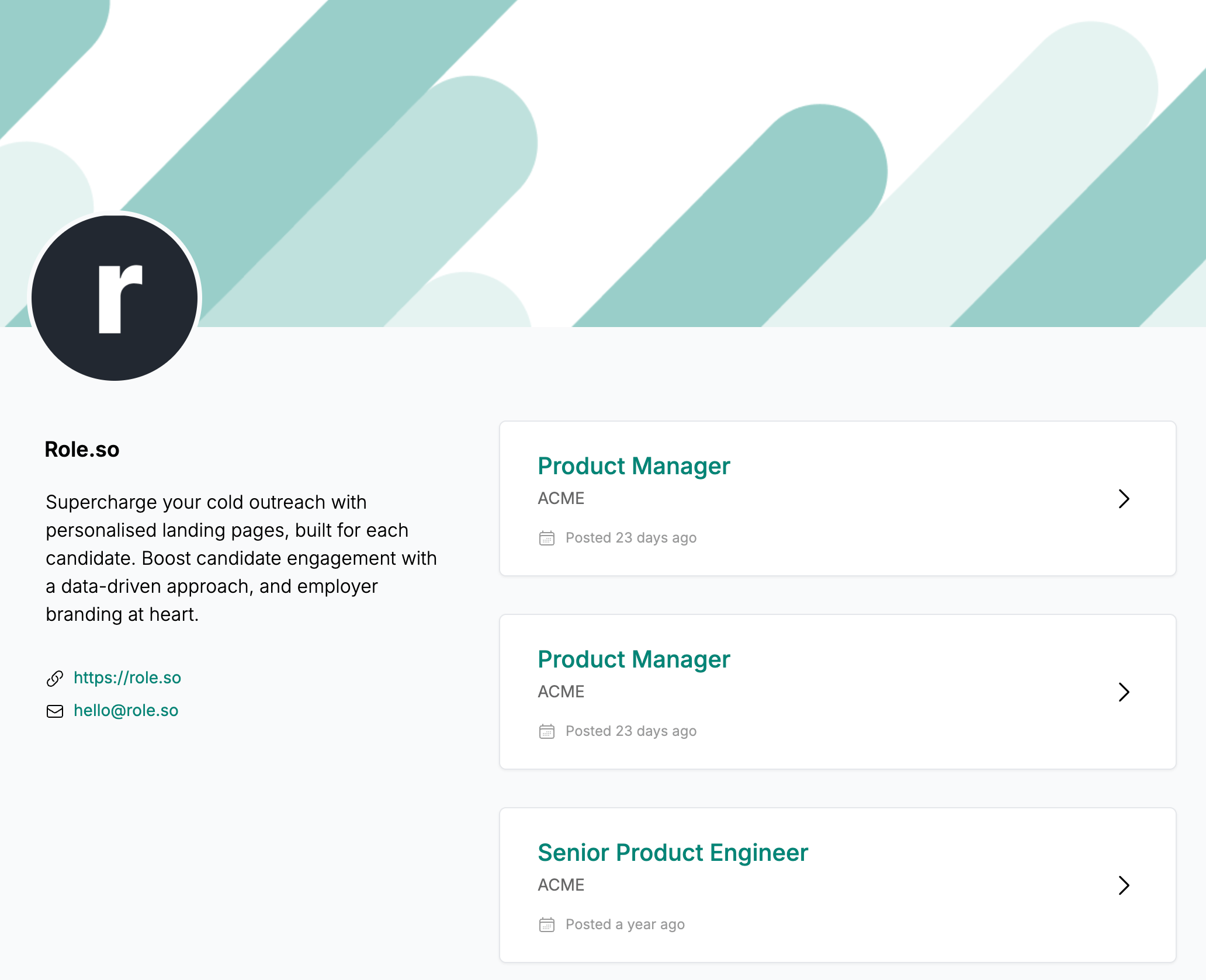
Role.so is built for the candidate-facing layer of recruiting: branded candidate packs, careers pages, forms, routing, and performance insight.
For a broader tool-level comparison, see how teams can use careers page software for growing teams while keeping the public candidate experience separate from deeper ATS workflow.
Forms, routing, and analytics
With Role.so, teams can:
- create candidate packs that work as richer role pages
- publish a careers page that lists published candidate packs
- customise the careers page URL, display name, description, links, avatar, header image, theme, and brand colours
- use a custom domain when it is configured
- publish or unpublish the careers page from the dashboard
- collect interest through configurable forms
- add a CV or file upload field to the interest form
- redirect candidates to a custom link, including scheduling tools or an external hiring system
- display interested candidates in the applicants dashboard
- add internal applicant notes and mark applicants as favourites
- configure email notifications, depending on plan and setup
- send interested or declined events through webhooks to tools that support them
- track candidate-pack analytics such as visitors, views, average time, interest, decline, response rate, referrers, devices, and top-performing packs
- capture decline reasons so the team can improve messaging over time
That makes Role.so useful when you want a stronger public hiring experience without pretending that the careers page is your entire recruiting system.
Example: a lean team hiring three roles
Imagine a small software company hiring for three roles: product designer, account executive, and backend engineer.
The team does not yet need a complex ATS rollout. What it needs first is a public hiring experience that does not look improvised.
A strong lightweight setup would look like this:
- one branded careers page introducing the company
- three candidate packs, one for each role
- each role page explaining the team, responsibilities, process, benefits, and FAQs
- an interest form with contact fields and optional CV upload
- email notifications or webhook routing for new candidate interest
- analytics to see which roles get attention and where candidates drop off
That is enough to create a credible hiring surface. If the team later needs more process depth, it can keep the candidate-facing layer and connect candidates into a fuller ATS workflow.
What to put on the careers page vs the role page
A common mistake is trying to make the careers page do everything. The careers page should orient candidates. The role page should persuade and clarify.
| Careers page | Role page or candidate pack |
|---|---|
| Company or team overview. | Specific role context and expectations. |
| List of open roles. | Responsibilities, requirements, benefits, interview process, and FAQs. |
| Links to website, social profiles, or contact email. | Candidate CTA, interest form, redirect, or application flow. |
| Employer brand and visual consistency. | Enough detail for a candidate to decide whether the role is worth pursuing. |
This split keeps the careers page easy to scan and gives each role enough depth to convert serious candidates.
Common mistakes to avoid
The biggest mistake is treating "without an ATS" as "without a process." Even a lightweight setup needs a clear path for candidate interest, ownership, and follow-up.
Avoid these mistakes:
- launching a careers page with no real role detail behind the listings
- using a generic CTA without explaining what happens next
- sending candidates to a form that asks for too much too early
- collecting applications without a clear review owner
- claiming the page replaces an ATS when the team still needs ATS-level workflow
- waiting for a full system migration when the public page could be improved now
The best no-ATS careers pages are not shortcuts. They are focused systems with a narrower job: make the public hiring experience clear, branded, and easy to act on.
How to decide if this is enough for your team
Use a simple test. If the main hiring problem is candidate-facing quality, start with the careers page. If the main hiring problem is internal process control, keep or choose an ATS.
- Do candidates currently have a credible place to learn about the company and open roles?
- Can each role explain enough context beyond a standard job description?
- Does the team have a clear way to collect, route, or redirect candidate interest?
- Can the hiring team update pages without waiting on a custom web project?
- Would a stronger public page improve sourcing, referrals, paid traffic, or inbound applications right now?
If the answer is yes, improving the careers page first is a rational move. If the answer is no because the internal workflow is already breaking, the careers page should be part of a broader ATS decision.
Build the public layer first, then connect the workflow
The strongest version of this approach is not anti-ATS. It is modular.
Start with a branded careers page and stronger role pages. Use forms, redirects, email notifications, applicants, and webhooks to handle candidate interest. Keep the setup flexible enough that a full ATS can sit behind it when the team needs deeper process control.
That gives candidates a better experience now and keeps the hiring team from buying more software than the immediate problem requires.
For teams ready to move, the practical next step is to start a free 7-day Role.so trial and build the first version of the careers page. If you want setup guidance first, see how to add a careers page, how to customise the interest form flow, or how webhooks work in Role.so.
Frequently asked questions
Yes. You can build the public careers page and role pages separately from a full ATS. You still need a clear way to collect, route, or redirect candidate interest.
Not always. You need an ATS when the team requires structured pipeline management, approvals, reporting, and internal process controls. If the immediate goal is a clearer public hiring page, stronger role pages, and a simple way to collect interest, you can start without one.
No. Role.so is best understood as the candidate-facing layer: careers pages, candidate packs, forms, routing, and analytics. Teams that need full internal pipeline management should keep or choose an ATS.
Yes. You can redirect candidates to an external application link, send events through webhooks to tools that support them, or use available integrations where configured.
Candidates can submit interest through a configurable form, upload files when the field is enabled, or be redirected to a custom link. The right path depends on your workflow.
Start with the basics: a credible company intro, clear open roles, stronger role pages, a specific CTA, and a clean way to route candidate interest.
Choose or keep a full ATS when the team needs structured pipeline stages, scorecards, approvals, compliance reporting, or deeper workflow controls.